Picture
Debra Lee Baldwin is the Martha Stewart and the Ellen DeGeneres of succulents--on one hand sophisticated and elegant; on the other, whimsical and wry.  I love her latest book, Succulents Simplified (which comes out tomorrow!) because even more than in her first two (Designing With Succulents and Succulent Container Gardens), DLB's voice comes through in her latest.  It's not an all-inclusive succulent bible, nor is it as design-focused as her previous books.  Instead, it's a fun, idiosyncratic, and informative romp in DLB's succulent-filled world. 

Succulents Simplified is divided into three parts.  The first is called "Enjoying, Growing, and Designing With Succulents."  It begins with lots of interesting succulent groupings (e.g., best blooms, picks for lazy gardeners, succulents you can eat if you're so inclined).  Then the advice begins.  There's a meaty little section with succinct riffs on topics like propagation, seasonal care, and dealing with pests.  This is followed by a section about design principles that's probably my favorite section in the whole book: chock full of terrific pictures, interesting container ideas, and short, informative blurbs with titles like "Not Your Grandma's Topiary" and "Why You Really Need Rocks."

The second part of Succulents Simplified consists of eight projects, ranging from simple to advanced, which showcase succulents.  I confess I'm not much on how-to projects; half of these were a little too Martha Stewart for me.  But reading them still gave me ideas and taught me a thing or two (e.g., that some people still own cake stands, and what good a fishing swivel might ever do me).  Plus, DLB offers plenty of tips, tricks, and fixes for making each project your own--complete with plant recommendations.

Succulents Simplified's final part features 100(!) easy-care succulents--and we're not talking about a crammed list with a couple of pictures here and there.  A photo, description, and growing tips are provided for each of the hundred varieties.  The breadth of DLB's selection is fun and impressive, and doesn't give short shrift to cacti or less-popular euphorbias (I maintain that haworthias got a short shrift, and she goes pretty heavy on the aloes, but YMMV). 

It's no secret that I'm a veritable Debra Lee Baldwin fan girl, and Succulents Simplified is sure to convert many more succ-ers into DLB-fan-girls (or fan-boys), too.  Although it was written for beginners and designed as a kind of "prequel" to her two other books, this one belongs on the shelves of novices and experts alike.  (Not to mention, it's paperback, and a bargain for $15 on Amazon.)  Even if you're a longtime succulent gardener, I dare you to read Succulents Simplified without learning something useful.


I never had a greenhouse until six or eight months ago, though I've wanted one since I was a kid.  My girlfriend is impressively handy, and constructed our greenhouse mostly from parts we salvaged for free from someone who was getting rid of her greenhouse.  (She says "we" built the greenhouse, but she was the brains of the operation, as well as most of the brawn.) 
Anyhow, I use the greenhouse partly for propagation.  I started many of my plants from leaves or cuttings.  The adromischus at the far left is just a few months old, the pachyphytum in the middle, maybe 4-5 months.  And the [echeveria?] at the far right is at least 8-9 months old.
For my small plants, I take those plastic nursery trays and fill them with 2" square pots.  This seems the most efficient use of space.  To the extent possible, I try to organize the flats by type--both for the sake of convenience and the ease of care.  Here's a flat of sempervivums.
And here's a flat of (mostly) echeverias.  As you can see from this picture and the previous one, very few of my plants are labeled.  Only recently did I realize how darn convenient it is to know what things are and when you got them (and if there's room on the tag, where from).  Nearly all of these echeverias here started last spring or summer from leaves.  They grew a bit over summer and fall, did basically nothing over winter (well, some died), and now seem to be enjoying spring as much as I am.
Once, when I happened upon a small nursery that was going out of business, I found this hard plastic thing in a corner of a greenhouse, all mud-covered.  They used it to grow agaves from seed, and sold it to me for $5.  Now I use it as a place to grow my teensiest plants--the ones that aren't ready for 2" pots yet: a stray sempervivum baby that falls off, a wee kalanchoe sprout, etc.  The little compartments are less than 1" square, so they hold quite a few plants and are great space savers.  Anyone know where I could get another one?  I've seen similar trays, but never made from hard plastic.
It is hard to overstate how much I love having a greenhouse.  I'm still getting the hang of it, and have learned that for many succulents, the heat and moisture it traps are sub-ideal.  I managed to cook--literally cook--a dozen or more plants, half of which are on the mend, and the other half of which now live in plant heaven.  Now I keep a closer (near-daily) eye on it, leave the door open, and cut a big slit in one side of the plastic covering to help air circulation.  I haven't had any more problems (knock on wood...), but I'd love to get tips from more experienced succ-ers on how you use your greenhouses. 
 
 
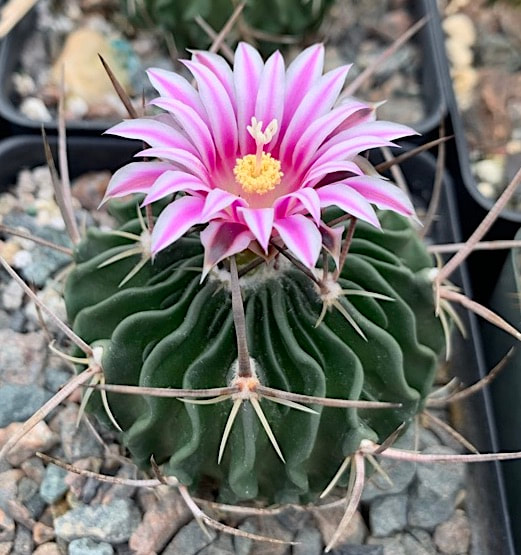
Seriously.  Like, what's the point of cacti?  They're spiny and poke you.

What's that?  They're not all spiny?  Some species of rebutia won't poke me at all?

Okay.  Well, cacti are boring, though.  They're all the same color--this super drab green that--

What?  They come in a ton of different colors?  Well, surely not pink or purple.

Both pink and purple??  Um.  Well, they'd hate my climate.  It's redwoody and kind of moist in the air, and most other succulents are fine, but cacti wouldn't like it.  I just--

What do you mean they're "versatile?"  And that they're even more frost-resistant than most other kinds of succulents?  Are you being serious?

You are.  Geez.  Okay, fine--twist my arm--I'll get a few cacti and plant them with some crassula and a baby agave.  If I have to.


For the record, I do not consider myself a "cactus person," but there are definitely a few I can't resist--sulcorebutia rauschii chief among them.  How did this happen?


I met a friend for lunch at the Stanford Arizona Garden today--a much-needed respite from a stressful past couple weeks!  I know I posted some pics back in February, but it's springtime now and looking amazing.  Here are a few shots I snapped.  Enjoy!
 
 
I was stressed out today, because I recently turned in an application for a job I'm really excited about.  At the same time, if I got it, it would entail some big changes for next year.  And in general--though the events of my life might suggest otherwise--I am not change's biggest fan.

So when I found myself just a mile and a half from the Gamble Garden in Palo Alto today, I had to pop in.  I looked at plants, took some pictures, and cleared away dead leaves.  It was nice there, peaceful and uncrowded, and I returned to my day with a slight reduction in stress.

Here are some pictures from my little afternoon visit.  Enjoy!

Does anyone else find themselves seeking out gardens, nurseries, or other places for looking at and/or procuring plants when life feels a wee bit stressful?  I bet I'm not the only one...
 
 
Picture
I was just looking at my last wish list post, and I realized that I'm 3 for 4!  Since posting that, I've added two small aeonium tabuliformes, two small blue flame agaves (one variegated, one not), and a haworthia truncata (pictured left), which has been thriving in my house for over two months now.  (Is that not one of THE most gorgeous truncatas you've ever seen?  Daaaayum.)

But--and I know I'm not alone here--the more I learn about succulents, the longer my wish list becomes!  Right now, there seem to be a lot of agaves on it, so I thought I'd just list all these drool-worthy agaves in a single post. 

Agave schidigera (Queen of White Thread-Leaf Agave).  Reminds me of my beloved, slightly mutilated quadricolor.
Agave Excelsior.  So gorgeous, right?  I took this pic at the Dry Garden in Berkeley, where it was priced at $50--eek!
Picture
via sunshinetropical.com
I've never met Gerhard, but I read his blog regularly, and it introduced me to agave "Joe Hoak."  WOWZA.  (Darn you, Gerhard!)
I love the red outlines on this agave "Royal Spine.

Are any of these on your lists?  What's your favorite agave?
 
 
As I'm sure some of you have experienced, succulent-ing can be a rough addic--er--hobby when you're on a budget.  I've particularly been loving haworthia lately, and what's a succ-er to do when she's lusting after plants that cost half her monthly food budget?  (I'm looking at you, Haworthia maughanii!  And you, variegated truncata!)

She grows from seeds, of course!  Some of these seeds are rather expensive themselves, but still nothing compared to full-grown plants.  (I think the most I paid was $10 plus shipping for 10 seeds.  And I really hope my girlfriend isn't reading this.)

So the excitement began.  Here's a snapshot of the little table outside our house where I do my planting:
Round 1 was a bust.  A big, fat, hairy failure of a bust.  Why, you ask?  Well, I read that for haworthia seedlings, you should sprinkle sand over the top after planting them in a thin layer of dirt.  The sand shades the tiniest seedlings and ensures drainage.  Sounds reasonable.

But why pay $6/bag for sand?  Clever girl that I am, I simply drove to the nearest beach, scooped a cup of the dry stuff into a plastic bag, and drove home (no doubt smug with confidence that I'd fooled the "system").

Well, nothing grew.  So I waited.  Still nothing grew.  Two weeks passed.  Give it time, I thought.  Succulent seeds can take a month or more to sprout. 

Two more weeks passed.  Nothing.  It was a little odd that none of the eight kinds of succulent seeds had germinated, but meanwhile, I set about other gardening tasks, which included figuring out how to get rid of the weeds that sprouted after the winter rains.  One site I read suggested using salt.  Salt, apparently, is poison for plants. 

Waaaaait a minute, I thought.  Salt = plant poison.  Beaches = salt.  So does beach sand = plant poison?!  ACK!
Picture
Well, the one wise thing I did while inadvertently poisoning my little seeds was not to plant ALL of the haworthia at once (though I did lose all my echeveria cante seeds and kalanchoe thrysiflora seeds, but those are more easily replaced).

So I tried again in mid-March, eschewing sand altogether this time, and planting in a container with half-inch squares for the seeds (too small, maybe?). 

In just two weeks, the glories of germination began to rain upon me!  Haworthia truncata seedlings!  Lithops seedlings!  And even one Agave Victoria reginae seedling!  (The AVR one is not as exciting as it sounds, since I planted five and only one germinated, but given my track record, any success thrills me at this point.)

At left, you can see a close-up of my seedlings being awesome little babies.  I ordered a few more kinds of seeds from a different source (Haworthia bayeri and Haworthia maughanii--wheeeee!), and intend to plant those later this month.

Meanwhile, though, I have had ZERO luck getting echeveria seeds to germinate.  (One of the dudes I got seed from threw in a zillion and a half echeveria afterglow seeds.)  They're just lurking beneath the soil, mocking me and refusing to grow.  So: have any of you succ-ers had any luck growing echeveria from seed?  What technique(s) have you used? 

OMG, I love spring SO much!


I went to Marshall's last week and it was inundated with plastic succulents!  I had never seen them before, and found them kind of bizarre.  Here's a photo:
If any of you succ-ers out there are contemplating a switch from regular succulents to the plastic kind, I want you to be able to make an informed decision.  Here's a chart to help you assess the pros and cons and decide which type is right for you.

Attributes of real succulents
  • Drought resistant
  • Can be propagated from leaves
  • Often locally grown
  • Susceptible to mealybugs
  • May burn with too much sunlight
Attributes of plastic succulents
  • Even more drought-resistant
  • Propagation from leaves may be difficult*
  • Often locally made**
  • Extremely pest-resistant
  • May melt with too much sunlight


* Experiments are inconclusive.
** If you live in China.
 
 
I recently received a grant to make a relatively small vertical succulent display where I work.  I've been trying to figure out exactly what I want it to look like.  Should it integrate art, or just succulents?  If art, what kind?  Succulent walls are becoming very popular, after all, and I want something a little different from the norm.  I'd especially like to emphasize texture.

After consulting with the good folks at Succulent Gardens in Castroville, I decided that I needed to experiment before buying anything major.  So I spent a small portion of my budget on test materials and test plants.  I started with a 12" x 12" square redwood frame designed for exactly this purposeThen I started to put my plants in:
As you can see above, I started right away with some plants not typically used in vertical gardens (with good reason, perhaps, but that remains to be seen).  Specifically, I started with a few different kinds of crested echeverias.  I tried to choose ones with the shortest, widest stems possible.  Then, with a nice clean knife...  I sliced them like cucumbers.  In case you're wondering whether it was terrible to CUT a beautiful crested echeveria, the answer is a resounding yes.  But I've heard that as long as you have some stem and root on each piece, the crests will re-root.  No idea whether this is true, but I guess I'll find out.  I arranged the crested slices to form a squiggly line, which I ended with some Mexican setosa.  As you might also notice, I tried two aeonium tabuliforme... we'll see.  If they work, it's going to look awesome.

Next, I started filling in the corners.  At the top, miscellaneous echeveria cuttings.  This is what most people use for vertical gardening--and for good reason.  They're bold and root quickly and look great.  But I've never been one to make things easy for myself...
What are those green bits in the bottom center, you ask?  Haworthia.  Two different kinds: cymbiformis and a dark green one that didn't come labeled but was busting out of its 2-inch pot.  Retusa, maybe?  Anyway, I broke these up into small enough pieces to poke through the wire.  I have no idea whether their roots will grow quickly enough to hold them in vertically, but that's what makes this particular frame "experimental," no?

As you can see, I added some other things, too: many sempervivums, mostly quite small (sempervivum tectorum on the lower right), as well as some more echeverias and on the far left, in the middle, two kinds of delosperma: spalmanthoides and congestum.  I should have gotten more of both, but I wanted to see how they worked before getting too many of them.  I've had good luck with delosperma spalmanthoides before, but they haven't been very fast growers for me in the past.  Anyone know where I can get a whole big bunch of it?

Another little experiment: a bunch of Sedum spathulifolium "Cape Blanco." These seem to be really awesome at filling in gaps, and were more fun to use than I'd expected.  Some are rooted, some not so much.  But they're pretty good growers, in my experience, so I'm hoping that after a couple of months, they'll all root firmly enough not to fall out when they go vertical.
Then it was time to fill in the rest.  I did this primarily with sempervivums, since I had quite a lot of those, but I threw in some surprises, too: a grapetopetalum, a grapetoveria "silver star," some weird unidentified sedum that kept falling apart on me, and some anacampseros (which I really like and have barely worked with, but it seems to be getting more popular).  Several of the plants I used were rooted, which meant that I had to spend quite a bit of time easing the roots through the wire (and often thinning them a little first). 

Here's the final product:
What do you think?

This was a useful exercise in that it helped me figure out a few succs I definitely want to work with and a few I definitely don't.  But I guess the key points will be (1) who survives; (2) who roots quickly enough to hold itself in? 

My problem is that I should wait about two months before I try to take this vertical...  But I'd like to start the rest of the project sooner than that.  Any ideas about how these might work?  Have any of you other succ-ers tried to use haworthias or sedums or delosperma or anything crested in your vertical gardens?
 
 
Picture
If you're looking for a project that's easy, small, cute, and takes less than five minutes to complete, consider sempervivums in shells!  All you do is take a little shell (the one at left is about an inch and a half across), put a pinch of dirt in it, and stick in a sempervivum rosette that doesn't have much of a root structure (offsets are perfect). 

If you want, put a few multicolored rocks on the dirt, like I did in the example below.

This is an embarrassingly easy project to write about, but it's cute and gets tons of compliments.  Great for small spaces like windowsills.

I spritz the dirt in these with a spray bottle about once a week.

What do you think?  Ever tried this?